Christopher Clark to receive European media award
출처 : DW (Deutsche Welle) May 19, 2022 (by Manasi Gopalakrishnan)
The eminent historian and academic is being awarded the Charlemagne Award for his work on Anglo-German history. We take a look at his illustrious career.
Groundbreaking analysis
Clark's arguably best-known book, "Sleepwalkers: How Europe Went to War in 1914," is an account of the events that led to World War I. The premise of the book is simple: did the Germans start the war that killed over 20 million people, or did most European nations simply "sleepwalk" into a battle of calamitous proportions?
"Sleepwalkers" gained much attention and a wide audience when it was published in 2012 because most readers compared it with Barbara Tuchman's "The Guns of August" (1962), considered until a decade ago as one of the best accounts of WWI.
According to Thomas Laqueur of the London Review of Books, Tuchman mentions the assassination of the Archduke Ferdinand and his wife Sophie in Sarajevo, but does not consider it of more importance than a triggering event. Clark, on the other hand, explains how the war happened. "It was the weakness and unreliability of the alliances, and the lack of certainty about who would be on whose side” that exacerbated the crisis in the summer of 1914, Laqueur writes.
What makes Clark's work so compelling however, is the fact that it is history written in this age. "In his introduction, Clark already makes one of the most interesting points. He reframes the First World War as a "modern event." A modern crisis, in his terms, is characterized through the existence of "suicide bombers and a cavalcade of automobiles," thus reminding us of the acts of terror which so profoundly shook the world during the 2000s," according to the journal Temoigner/Getuigen.
Keeping sight of ‘historical truth'
Clark's other books include, "Iron Kingdom: The Rise and Fall of Prussia 1600-1947" (2006), "Time and Power: Visions of History in German Politics from the Thirty Years' War to the Third Reich" (2018) and most recently, "Prisoners of Time: Prussians, Germans and Other Humans" (2021).
"Iron Kingdom” details the history of Prussia, from its beginnings to the Third Reich, and how it transformed into a major European force by the late 19th century. Clark also discusses the devastations of the Thirty Years' War and the "iron and blood" policies of Otto von Bismarck during unification in 1871 as well as its implications for the 20th century.
In "Time and Power," published by Princeton University Press, Clark demonstrates how the exercise of power is shaped by the perception of time. He draws upon four key figures in Germany, including Friedrich Wilhelm of Brandenburg-Prussia, Frederick the Great, Otto von Bismarck and Adolf Hitler. While Friedrich Wilhelm, for example, rejected continuity with the past and entanglement with tradition, Adolf Hitler sought to evade history altogether, and emphasized racial archetypes and a prophetically foretold future.
In his 2021 book, "Prisoners of Time," a compendium of essays, Clark raises questions about how we think about the past, and the value and pitfalls of history as a discipline. An essay in the book titled "The Dream of Nebuchadnezzar," according to The Guardian, "is a bravura exploration of the role of political power in history…The story is both a fable of power, and as Clark explains, the beginning of the understanding of history as a foreordained sequence of hegemonies."
It's hard to shake that idea, The Guardian quotes from the book, concluding, "The pleasure of Clark's writing is that it embraces an impressive spectrum of thought, without ever losing the sight of the historical truth, or of the difficulty reaching it.
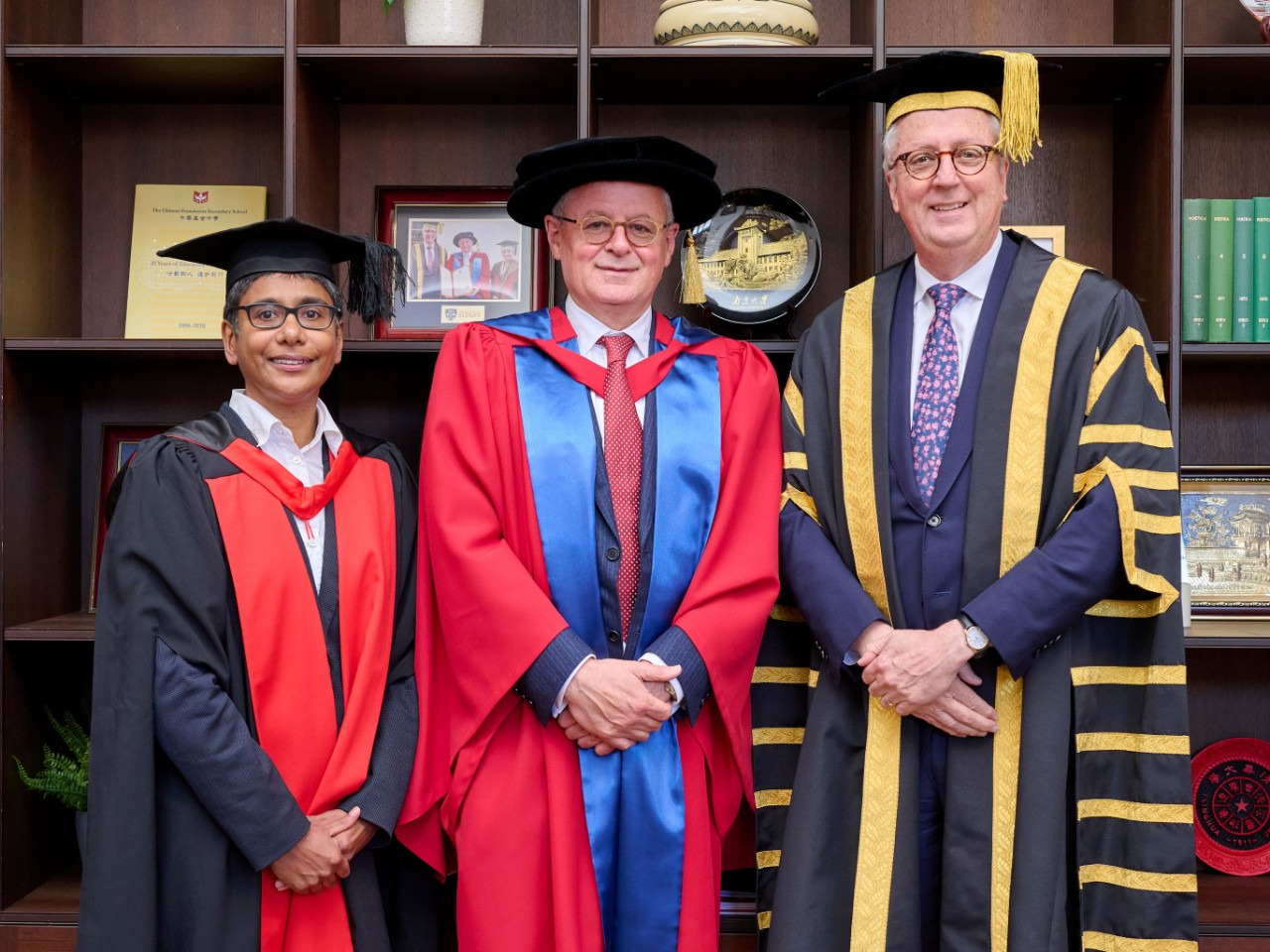
Professor Azrini Wahidin, Head of the School of Social and Political Sciences (left), Sir Christopher Clark, and Vice-Chancellor and President, Professor Mark Scott (right). [사진 및 기사 출처 : The University of Sydney)

Sir Christopher Clark has been admitted to the degree of Doctor of Letters (honoris causa) in recognition of his exceptional contribution to international relations and the study of history.
A graduate of the University of Sydney and one of the world’s most distinguished historians, he received his PhD at the University of Cambridge – at which in 2014, he became the twenty-second Regius Professor of History.
Sir Christopher is regarded internationally as a leading historian of nineteenth-century Germany and continental Europe. His writings have brought a new understanding of the modern relevance of studying the causes of war, particularly the First World War and the European revolutions of 1848. He is widely acclaimed as a German history commentator and often appears on German and British television giving analysis of Modern and historical politics.
Upon conferring the honorary doctorate to Sir Christopher, Vice-Chancellor and President, Professor Mark Scott AO highlighted how his work as a historian has greatly enhanced our understanding of the factors that lead to conflict.
“Sir Christopher is a truly outstanding historian of great academic eminence whose writings have contributed pivotally to the thinking of the Western world about the combination of factors that led to the First World War, and which remain profoundly relevant to the analysis of conflict causation and prevention in our modern world.
“His widely praised and award-winning books represent scholarship of the highest order. The critical reception of his best-selling history of Prussia, Iron Kingdom: The Rise and Downfall of Prussia, 1600–1947, gave him a public profile that reached well beyond the academic world. It won the 2010 German Historians' Prize, making Sir Christopher the first non-German to receive this award.
"His two most recent and extraordinary books on the causes of conflicts have shaped and continue to shape our world and have absolutely cemented his international reputation as a leading historian of our times.”
Sir Christopher is a Fellow of the Australian Academy of the Humanities and a Fellow of the British Academy. He was a member of the Mannheim-based Prussian History Working Group and the Prussian Historical Commission and became a senior advisory member of the London-based German Historical Institute in 2010.
Beyond his academic achievements, Sir Christopher’s works have earned him many awards and accolades, including the Wolfson History Prize, the History Book Award of the Queensland Premier's Literary Awards and the General History Prize of the NSW Premier’s History Awards; the Los Angeles Times Book Prize for History; the Pour le Mérite for Sciences and Arts, and the Laura Shannon Prize; which is awarded annually by the University of Notre Dame.
Both the British and the German Governments have honoured him for his service to Anglo-German relations. In 2010, he received the Officer’s Cross of the Order of Merit of the Federal Republic of Germany and was knighted on the recommendation of the British Foreign Secretary in the 2015 Birthday honours
'나의 이야기' 카테고리의 다른 글
| 쇼펜하우어가 묻고 니체가 답한다면 (0) | 2025.09.16 |
|---|---|
| JTBC 드라마 백번의 추억 Wahnsinn 베를린 100번 버스 (0) | 2025.09.15 |
| The Loom of Language (by Frederick Bodmer) (0) | 2025.09.09 |
| 독일 세무회계사무실의 인공지능(AI, KI) 활용 (0) | 2025.09.07 |
| 은퇴(Ruhestand) : 독일의 퇴직연금 (0) | 2025.09.01 |